























A wave of bomb threats targeted 13 synagogues across Connecticut in December of 2024. These threats rattled the sense of security in towns that had long considered themselves insulated from such hate. In Weston, a Jewish leader in charge of a diaper drive opened a letter that read: “Hey b*tch. Heard you were collecting diapers. Hope you send them to Gaza!! F YOU and F ISRAEL.” In the days following, a Jewish individual attending synagogue in Ridgefield was harassed when someone screamed, “What if I chuck this coffee in your face, you Ashkenazi Jew? I used to beat your dirty kind in New York.”
These aren’t isolated outbursts; they are data points in a staggering trend.
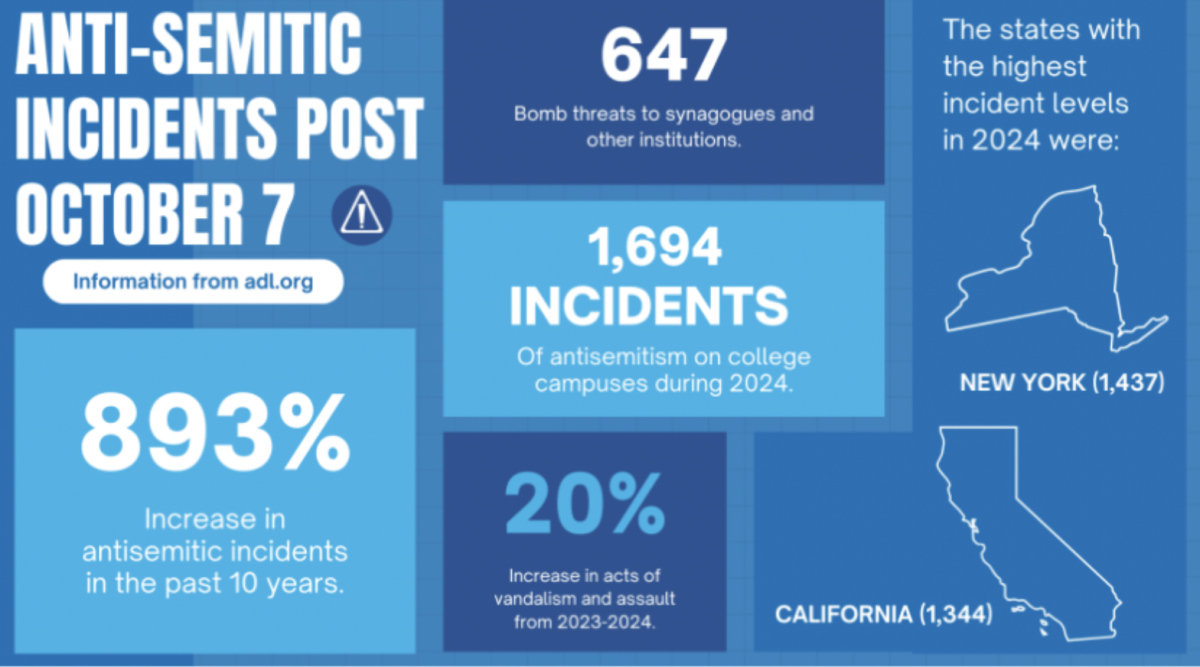
According to the Anti-Defamation League (ADL), Connecticut saw 557 antisemitic incidents in Connecticut from 2023 to 2025. Nationally, an increase has been tracked in the past three years. According to their 2024 Audit, antisemitic incidents continued to rise at an alarming rate: 9,354 antisemitic incidents were tabulated across the United States. This represents a 5% increase from the incidents recorded in 2023, a 344% increase over the past five years and 893% over the past 10 years. What was already a record-breaking year in 2023 was surpassed again in 2024, signaling a sustained rise rather than a temporary spike.
But in response to these antisemitic incidents, Staples High School has moved to the front lines to protect Jewish students, centering its response in the classroom. Rather than avoiding the tension, the school’s social studies departments are tackling it through a historical lens, replacing traditional lectures with discussion-based analysis of primary sources.
“One of the first days coming in, I just had [students] take out their notebook and do a little free writing,” social studies teacher Nell-Ayn Lynch said. “Even if some people didn’t know anything about [the conflict].”
In her honors United States history course, the global climate dictates the curriculum. Each week, students must analyze three different perspectives on a current event. Dr. Francesi, the social studies department chair, strongly recommended utilizing Facing History & Ourselves, a non-biased source with several Jewish affiliations.
“You’re going to read about how this all transpired,” Lynch said. “It will be a conversation that’s constantly ongoing.”
The everchanging climate of the war proved difficult to teach in real time, as teachers balanced historical context with students’ emotional responses to ongoing events. However, the research-based curriculum encouraged students to express any questions or general thoughts on the subject.
On top of the educational curriculum following the Oct. 7 attacks, Westport’s Jewish population allowed students and adults to seek guidance outside of school as well. Miri Dubrawsky, CTEEN director at Westport Chabad, has observed a shift in the town’s pulse.
“I think that it was actually probably, in all my years of living in Westport, one of the most unifying times for the Jewish people in towns,” Dubrawsky said.
Through CTEEN, local students have found a space to celebrate their identity amid the hostility. Dubrawsky noted the emergence of the “Oct. 7 Jew,” individuals who, in the wake of the attacks, felt a sudden need to reconnect with their heritage and community.
While education and community can not singlehandedly combat the antisemitism that looms in Connecticut, the top priority from Staples is to ensure students are safe and supported no matter their religious or cultural background. In VJ Sarrulo’s three years as athletic director, only three antisemitic incidents occurred against Staples students.
“When that happens, we activate a response protocol,” Sarrulo said. “First thing is to make sure that, most importantly, that our students are safe, that they feel supported. Same with the families of the student athletes that are involved.”
Similar to educational protocol, the school formalizes a zero-tolerance policy. In the few instances of antisemitism, this policy has been generally well received by students and families.
Gabe Hellman ’26 experienced an online antisemitic comment when a soccer player from Greenwich implied his FCIAC win did not mean anything due to his Jewish background. The incident was reported to Sarrulo, who ensured that Hellman and his family were supported during this. Although consequences were left anonymous, Hellman acknowledged the level of support and action from the administration and Sarrulo.
“In Westport, all religious beliefs are accepted and there aren’t usually many occurrences of direct antisemitism like the reply left on my comment,” Hellman said. “Westport is very accepting. Unfortunately, outside Westport and in the real world, I can’t say the same.”