

















On weekdays, he stands in front of a classroom of 20, dry-erase marker in hand, gently guiding students through trigonometry, logarithms and rational functions. On weekends, however, he steps onto a much different stage – one defined by stage lights, roaring applause and 70’s British rock.
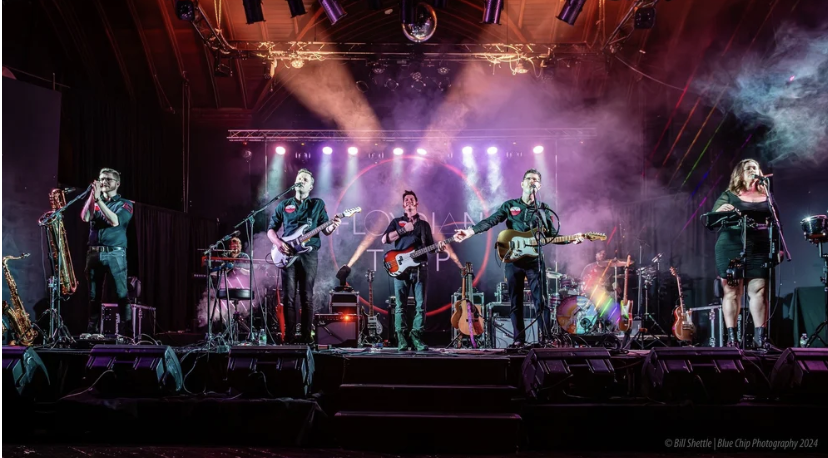
To his students, Mike Forgette is a humble math teacher known for his enthusiastic lectures, signature 9-point grading system and habit of wearing purple pants on Mondays. To hundreds of strangers packed into venues across New England, he is something else entirely. Outside of the classroom, Forgette is a founding member of “Floydian Trip,” a Pink Floyd tribute band that has become a well-known regional act.
The band formed in 2022 when a previous musical collaborator of Forgette’s reached out with the idea of forming the group.
“The guy who was putting it together reached out to me and said, ‘I am putting this band together’ […] and then I helped find some of the other [members.]”
The band’s mission is simple: recreate Pink Floyd’s music as faithfully as possible.
“Very, very little of it is our own spin. A lot of it is trying to replicate the sound,” Forgette said. “The only thing we don’t try to do is voices because Pink Floyd’s a British band and we’re not British, so we don’t do the fake British accent.”
Their approach has resonated. Since their first performance in 2023, Floydian Trip has progressed quickly, moving from town greens and festivals to bars, breweries and eventually full theaters. Today, the band plays almost exclusively in theaters, including a sold-out 800-seat venue in Maine.
“We grew a lot faster [as musicians] than any of us have ever grown in other bands,” Forgette said. “In terms of progression, we’ve seen a lot of increase in quality of gig and in type of venue and audience size, very fast.”
Forgette developed a love for music early in life, first learning to play the flute by ear at age 5. In seventh grade, Forgette transitioned to guitar and went on to play in different bands during high school. In college, Forgette studied music and sound recording with a minor in theatre. Teaching was not originally part of Forgette’s plans until he took a job with an SAT tutoring company; the job helped him link his love of performance with teaching.
“[After my first session teaching] I had this just feeling of like, oh my gosh, that was really fun. [I] never really considered teaching as a profession until that job, and it definitely was because of that performance element,” Forgette said. “I liked being the center of attention, I liked performing, and I saw teaching, and still do see teaching, as a kind of performance.”
Despite the obvious differences between a classroom and a concert hall, Forgette believes the two worlds are related.
“It’s definitely the performance that informs the teaching,” he said.
Given Floydian Trip’s high volume of shows (~25 per year), Forgette has become accustomed to being in front of a crowd.
“At this particular moment, performing in front of people is no longer nerve-racking and stressful for me; it’s just fun. But one of the reasons that that’s the case is because we’ve played so many shows,” Forgette said.
Being in a band has also helped him connect with students.
“Anytime students figure out that I’m in a band […] that’s an immediate like, wait—what? And then there’s interest there,” Forgette said. “I think it helps in establishing some connections with some students.”
Floydian Trip’s growth has not come without recognition; in 2025 they were named “Best Band” by the Hartford Advocate. It was an award that Forgette described as “very, very nice.” Still, the band is not planning any expansion outside New England in the near future, given the difficulty of balancing additional travel with work.
Instead, the group’s goal is sustainability: consistently selling out mid-sized theatres and continuing to refine their act.
“The guy who created the band, his goal is to do really good size theaters several times a year. So like, 2500-seat theaters, sell them out, and be able to sustain even if it’s only 10 to 15 shows a year.”
On Monday mornings, Forgette returns to his classroom, trading guitars for dry-erase markers. On weekends, he travels across New England performing music that has endured for decades. Both roles are demanding in their own ways, but whether under stage lights or fluorescent lights, he is doing the same thing: captivating an audience, be it one lesson or one song at a time.