






























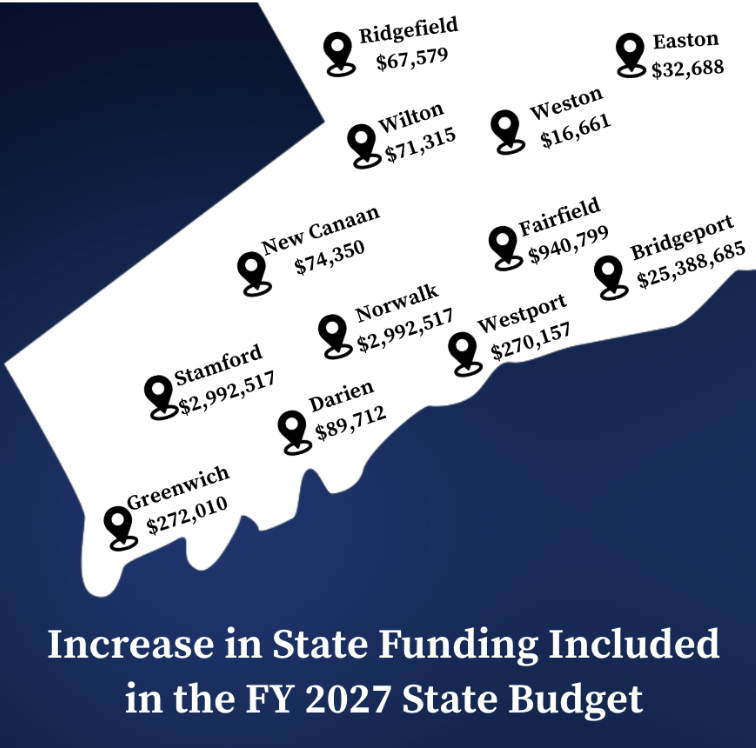
All Connecticut towns have been arranged to get an increase in state financial support according to the town-by-town increase in funding for the FY (fiscal year) 2027 state budget announced by Connecticut Governor Ned Lamont on May 5, 2026. The FY 2027 is a financial plan that is utilized by state governments to keep track of tax dollars and how they contribute to town needs.
According to CT.gov, the money Connecticut has for funding supplemental education aid has increased by an astounding $172,923,686 for the entire state, and increased by $81,474 for the town of Westport. Statewide, the budget for supplemental town funding as a whole has increased by $100,000,006 and increased by $188,683 in Westport. Overall, the FY 2027 state budget for the state of Connecticut has increased by $272,923,692 that will go towards making all towns across the state better by contributing more money towards education, healthcare, and infrastructure..
This drastic increase in funding will do a number of things to make the state of Connecticut a better place. Most notably, putting more money towards the education systems of our towns.
“The budget provides an additional $193 million in supplemental education grants for towns and cities, including $162.2 million in direct aid to municipalities, $8.7 million for charter schools, $8.3 million for magnets schools, and $800,000 for vocational agriculture programs – representing an increase for all Connecticut public school students – and approximately $10 million in temporary educational aid,” according to CT.gov.
Since Governor Lamont took office in 2019, Education Cost Sharing grants have grown by roughly $444.9 million – an 18% increase in support for K-12 public schools. The budget includes Governor Lamont’s priority investments in children’s education, including $12 million for universal free school breakfast to ensure all 500,000 Connecticut students have access to a healthy meal to start the school day; $5 million to expand impactful mental and behavioral health supports in schools; $2 million to fund 75 teacher apprentices per year (providing stipends, mentoring and tuition supports, among other benefits to trainee teachers); and $2 million for a new literacy coaches program.”
The budget also contributes to academics, as schools are being provided with more money to put towards training and supporting educators, ensuring that the students at these schools are not only healthy and safe, but also receiving the best education possible.
This significant boost in funding for FY 2027 is due to the negative response Lamont received from several superintendents when he first proposed the state budget. Superintendents expressed grave concerns for the budget’s ability to provide and meet the needs of their school systems and students. After several complaints from students, parents, superintendents and mayors, Lamont began working towards a new spending plan that could effectively meet the needs of all communities across the state.
“We heard the same, consistent story no matter if it was a small town, medium sized city, big city. I just heard every moment from boards of education and mayors: ‘Help us out. We’re having a hard time maintaining the quality of our education,’” Lamont said in a press briefing on May 7, 2026, according to CT Insider.
Connecticut, specifically Fairfield County, is a very economically diverse area, and the public school systems are a clear reflection of that. Prior to this new FY budget, the funding for Westport Public Schools’ 2025-2026 school year was estimated to be $150.6 million, according to the Westport Journal, whereas the funding for Bridgeport Public Schools for the 2025-2026 school year faced many ups and downs, including a predicted $45 million deficit for the 2025-2026 school year, as the needs of their public school system were not met with the budget they had for the previous FY state budget, according to the CT Mirror. However, this update to the FY state budget has given not only Bridgeport, but several other Connecticut public school systems the chance to improve and to better meet the needs of their students.
“At Staples, we have strong funding and we live in a very privileged community where funding really positively impacts student experiences and education at Staples,” Alexa Wolff ’27 said. “Because we have such generous funding, we’re able to get a great education, which is one of the reasons why Staples is ranked as the best public high school in the state.”