























Most high school athletes finish their seasons close to home. But from Feb. 19-21, the Staples girls’ squash team packed their bags and headed to Philadelphia to compete against some of the strongest programs in the country at High School Nationals.
While the squash regular season runs from mid-November through late February, Nationals marks an entirely different level of competition. Held each year in Philadelphia, High School Nationals is the world’s largest squash tournament with more than 1,700 players competing on 210 teams across 14 divisions (boys and girls). Teams from across the country, many of them private and boarding schools with long-established squash teams, come together for three intense days of competition.
The girls teams were organized in six divisions of 16, with the best teams in Division 1. Staples entered the tournament in Division 3, a step up from Division 4 last year. Divisions are determined by the team’s average skill rating, and while every team is invited to complete, placement reflects overall strength. Moving up a division meant tougher opponents and tighter matches.
“The first two matches were both very close, only losing by a game or two,” Eliza Greenspan ’27 said. “But in our last two matches we crushed the opposing teams.”
The team ultimately finished 13th out of the 16 teams in their division, placing them 45th nationally. Although the record may not tell the whole story, the level of competition was notably higher than in previous seasons.
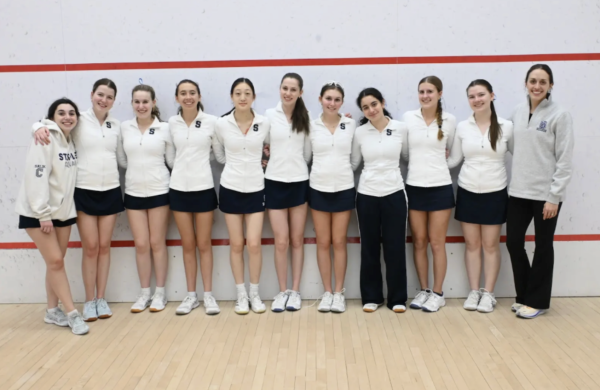
During the regular season, Staples competes in the FairWest League, one of the strongest public school squash leagues in the country, alongside teams like Darien, Greenwich, Rye and Bronxville. This year, Staples won four of its eight regular-season matches and placed fourth out of seven teams in the division.
“Our hardest match is Darien,” Rebecca Schachter ’26 said. “They have a lot of really good players and it was challenging for the whole ladder.”
Nationals, however, brings new challenges. Unlike regular-season matches, where the full roster competes, only the top seven players represent their team at Nationals, with additional players serving as alternates. The schedule is also more demanding, sometimes requiring the top players to play multiple matches in a single day.
To win a squash match, a player must win three out of five games, each of which are played to 11.
“We play four to five matches over three days,” Schachter, who played number one singles and won three of her four matches at Nationals, said. “The matches are against teams from all over the country.”
While most of the individual matches last less than thirty minutes, one of the most intense matches was Staples’ third match against St. George’s School (from Rhode Island). At number three singles, Piper Salik ’28 lost her first two games, but then came back to win the next three games, finishing in just under two hours.
Staples matches were all against private schools, losing to Phillips Exeter Academy and Kent School, and then beating St. George’s School and Westminster School.
What makes Staples’ presence at Nationals particularly notable is that it is a public high school—something relatively rare in the squash world.
“It means a lot that Staples offers squash as a sport,” Greenspan said. “Every time I tell someone I play squash at school they are always super surprised. It’s so rare that a school has the resources for a squash team and I am super grateful that Staples does.”
For many players, the team aspect sets school squash apart from the individual nature of club competition.
“I play squash outside of school individually, which is a lot of pressure and is intense,” Schachter said. “Playing with a team at school brings a lot of fun and enjoyment to the sport. I really enjoy cheering each other on and hyping up all the girls playing.”
That supportive culture is a defining characteristic of the program. Both Varsity and JV practice together, team dinners are common, and upperclassmen make a conscious effort to mentor younger players.
“The team does not take itself too seriously,” Greenspan said, “and it’s a super friendly and supportive environment.”
As the season closes, Nationals serves not just as the final competition, but as a reminder of how far the program has come. And with a rising division placement and tight matches against top teams, the future looks even stronger.