
































It seems as though every other article is taking part in the great debate over tech usage. People are slowly turning away from rampant entertainment and shiny things and turning towards things like analog clocks and flip phones, while others are more glued to their screens than ever before. This begs the question: what’s the current standing on this tug of war, and what will tech giants do in coming years to hold what attention spans they can?
These grasps for audience are growing more and more extreme. With sites like TikTok and Facebook being exposed for pushing posts with negative reactions to keep people hooked on the anxiety of the scroll, the next worst headline, the next political hot button topic, the next heated argument over a celebrity (who you would think users knew personally from how they speak about stars’ personal lives and feelings). Algorithms that feed off of fear mongering and negative emotions were only the first of many attempts, and they succeeded, with users birthing terms like “doomscrolling” from the resulting behaviors. But now people are turning again and a greater tidal wave must come to pull users back out to sea from the offline shore.
The vicious trend cycle shows us people get bored quickly, and if there isn’t enough engaging content for their algorithm to feed them, why not just give them a seemingly infinite creator? AI. But what happens when the concept of AI grows stale or distasteful? If the anxiety held a small grasp maybe there’s something to grasp onto in a deeper human emotion: grief. Calum Worthy who co-starred in the beloved Disney Channel show Austin and Ally as Dez Wade recently launched an app called 2wai, where users can “speak” to dead relatives simulated by AI. In the first episode of season two of the Netflix hit “Black Mirror” a woman brings her husband back to life through an AI powered robot, played by Domhnall Gleeson, who actually has a shocking resemblance to Worthy. The episode is a warning of how grief can lead to dangerous paths of coping, and how you can never truly bring someone back. It’s a devastating but necessary truth, and is part of what makes life so precious. You truly cannot be replicated, there are things your algorithm will never know. Even if there was a camera on you 24/7, you still have your deepest innermost thoughts. So while they may try to hook you by manipulating your grief, at least they’ll never be able to fully replicate your thoughts and feelings, right? Well, maybe.
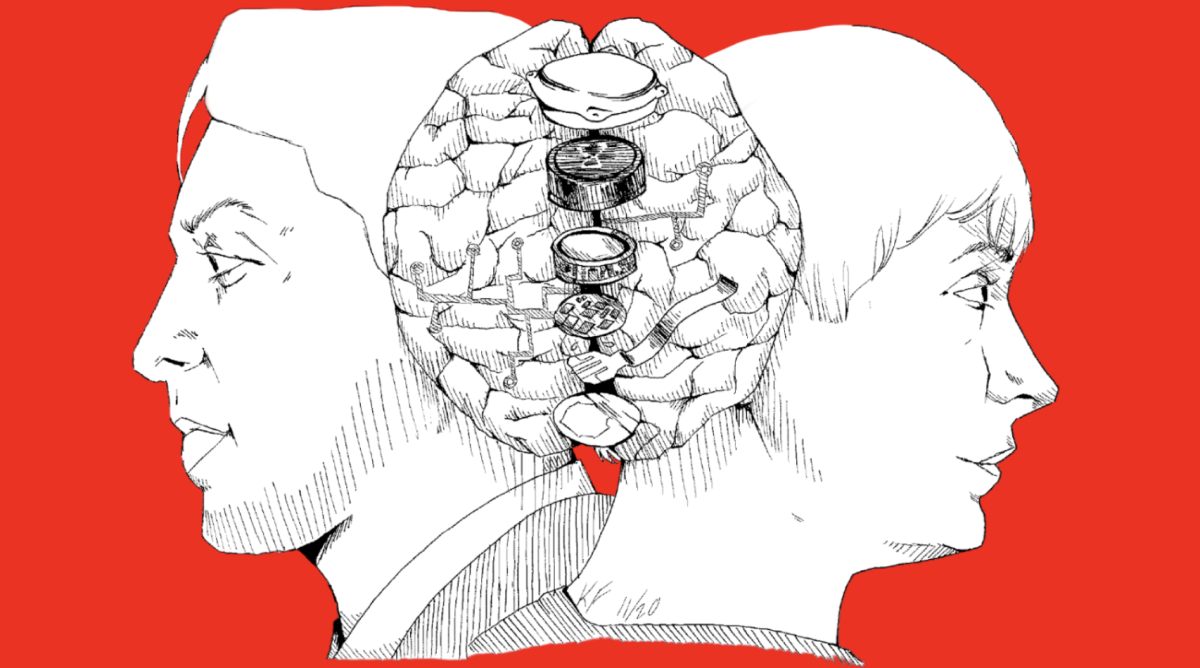
If you can recall what I said about the push back on tech urging users to put down their phones, it seems one of the “solutions” created by tech giants to keep us wired in is a device you can’t put down, unless maybe you’re resting your head on your pillow. Neuralink. A company owned by X (formerly Twitter) CEO Elon Musk that produces implantable brain-computer interfaces (BCIs): a small round disc shaped chip with exposed thin threads that track neural activity. Essentially, a computer integrated into your mind. The concept is dystopian, and also already has its own Black Mirror episode (season 1, episode 3 “The Entire History of You”). And while these technologies can aid those without motor, vocal or other functions that make it difficult to communicate, it can also be used against us if it ever were to become accessible to the average person.
While we can put our phones down and subsequently stop the advertising and data collection, soon enough it may not even be a choice to do so. “There are neurons in the brain that carry information about everything we see, feel, touch, or think,” The header of the Technology section of the Neuralink website reads.
So, what do we do? The power of these apps lies in engagement. Without engagement they cannot gauge what phone case pattern you may want to buy or what language course to advertise to you based on your travel research. The usage is building data; we’re all aware that the little cookies you accept on your browser are data, but we often don’t realize the value of it. You may think “how is it dangerous for Apple or Google to know my favorite brand of jeans?” But you as an individual are part of a much bigger equation because it isn’t just you. Their first few jean ads may not hit, but eventually they’ll strike. You’ll buy maybe once or twice from an ad. Not much profit for only one purchase a year it seems, so it can’t be that exploitative. Unless you multiply it by the billions (73.2% of the population as of Oct 2025) that use the web, and also account for the people who buy more than a few things from advertisements. You are being sold to, not just having products pushed, but mentalities as well that promote spending. “Buy this yoga mat for optimal comfort while doing our free trial pilates course.” The ad may not work, you may feel like you spent no money at all, you are free from influence. But, it might cause you to stop and consider purchasing a new mat the next time you’re at Target. It’s subliminal, and now the tech sphere wants to enter our subliminals.

