

























Since the release of ChatGPT, AI use in schools has become both widespread and contentious. What began with students now increasingly includes teachers.
In fact, Westport Public Schools is looking to embrace AI to enhance the learning environment through a district-wide initiative to introduce easy AI tools for staff. So far there have been a number of programs that teachers have been encouraged to use.
“The main tools teachers have been guided to use with their students [are] School AI, Magic School, Adobe Firefly, and AI features within Canva. Those are all data privacy compliant,” Head of Technology Natalie Carrignan said.
Administration is currently working on offering another AI tool to be implemented in the coming months.
“Teachers who are interested have the opportunity to try Google Gemini,” Principal Stafford W. Thomas Jr. said. “It will be more widespread in the district next semester and certainly next year, in terms of the number of Pro accounts teachers are able to get for free.”
Despite the number of resources available, some students believe AI should not be used by teachers in any way.
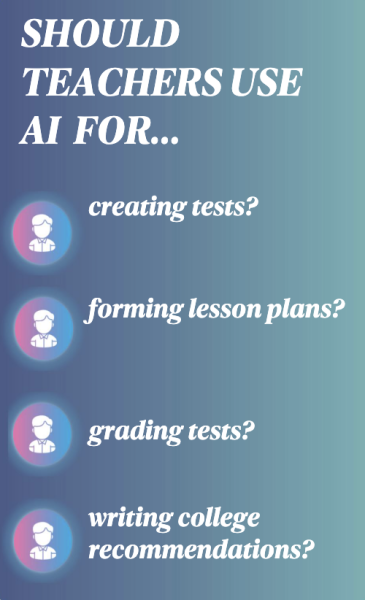
“It is not okay for teachers to use AI for tasks that require human subjectivity,” an anonymous student wrote in an Inklings survey. “This can include things such as grading, creating assignments or tests, and planning lessons.”
On the other hand, some students see possible benefits of AI usage by teachers.
“Teachers can use AI in ways that push the boundaries for what they can provide to their students,” a second survey responder wrote. “My computer science [teacher] using AI to create study podcasts, is a great example of this.”
In some classes, such as Science Research Honors, AI is used openly. Science Research teacher Amy Parent has her students use ChatGPT as a lab assistant.
“I’m using it [for] informational gathering, not writing,” Parent said. “We have a database called PubMed… where you can find articles; [however], AI has a way of finding articles more quickly than PubMed… so I’ve become more efficient in supporting my students.”
In contrast, teacher AI usage in the English department has been much slower. In many cases, teachers are creating paper assessments to further inhibit the use of AI anywhere in the classroom.
“I think what we do in the English department hasn’t changed all that much,” English teacher Mary Katherine Hocking said. “I feel like the format, though, has changed… to in class on demand essays, sometimes done by hand to avoid any AI input outright.”
Still, many other teachers are enthusiastic about AI, viewing it as a new way to provide support to students on a scale not previously possible. For example, some special education teachers have embraced the technology for its ability to quickly adapt coursework to meet a wide range of student needs.
“[I use AI] for goal work in class [that] I need to create for students,” an anonymous special education teacher wrote in the Inklings survey. [“I think] students can use AI to support their learning, such as making practice exams, getting explanations for topics or units they do not understand.”
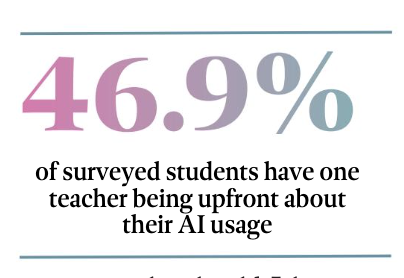
However, despite its widespread use, transparency around teachers’ AI use has become an increasing topic of discussion among Staples students. Some students feel that teachers have not been upfront about when AI is used to generate assignments.
“It made me not really take [the assignment] seriously because it felt like they weren’t taking it seriously,” Maia Lange ’28 said, recalling a teacher’s assignment Lange suspected was created with the assistance of AI. “They didn’t make the assignment, so why should I have to do it?”
Students also have had strong reactions upon learning some teachers have relied on AI to help write college recommendation letters.
“[I feel] [e]xtremely disrespected,” a student survey responder wrote. “For the years that I’ve been in the Westport district, I’ve been taught that using AI, especially on important assignments, is prohibited. It just shows that you can’t practice what you preach and if you can’t even abide by your own rule then how could you expect your students to?”
Despite wavering opinions on teacher AI use in general, 87% of the 115 of surveyed students hoped that there will be a formal policy outlining how teachers may and may not use AI. Currently, no such policy exists.
Principal Thomas has indicated that a more comprehensive idea of AI usage has been an ongoing discussion during the Board of Education meetings.
“Certainly we’re looking to embrace it,” Thomas said, “but it’s going to take place at different speeds and in different departments.”


